Trees don’t disturb

The thirtieth:
Time to remember

Article published in October 2014

oct

Years ago, a newspaper published a fact happened in a small brazilian town. Men and women united, decided to cut down all the trees of the street were they used to live. Reason: women meant it was too much work to sweep the fallen leaves. By their turn, men got irritated with the dirt made by the birds, because it harmed the paint and the windshield of the cars parked under the trees.

Bad business. If momentarily they got rid of two cleaning tasks, on the other hand they have lost several services that trees do to us:

1. The city temperature rises in the presence of vast cemented and asphalted areas. The existence of trees helps to fight this thermal pollution (excessive heat).

2. Trees help to keep balanced the air humidity. The dryness sensation is softened in gardens, parks or in streets surrounded by many trees.

3. We need oxygen to live, and it is produced by the trees. The presence of more trees around means breathing a cleaner air, being healthier and enjoying more well-being.

4. Many birds build their nests on trees (they dwell there…). They have therefore a place to live, and help the reproduction of trees and other plants.

The list keeps going. It is regrettable, but even today there is no agreement that planting and keeping trees is more favorable to the human species than getting rid of them. Many put commercial interests, real estate increase in value or sheer convenience above everything.

It is a matter of attitude, and this is the most difficult thing to change, if we want to improve the quality of life in the cities.

Clouds, rain and pools of water

The thirtieth:
Time to remember

Article published in September 2014

2017_Sep

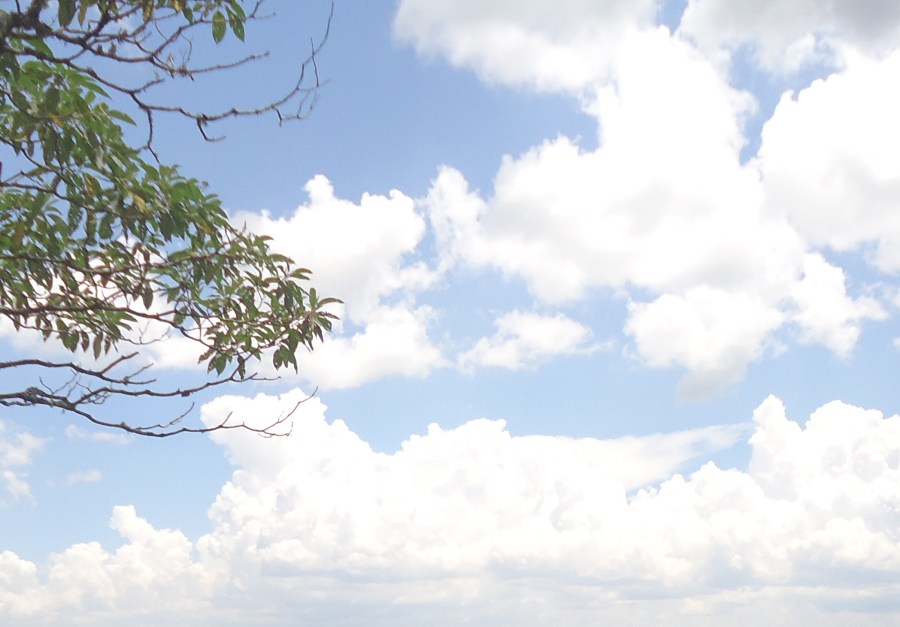
From the window of your house, you can see a pool of water on the ground. After a while, it starts to vanish. Water begins slowly to evaporate and change place. Now it is in the sky. You look above and see a huge and plump cloud, carrying all the water that once was so close to you.

More time goes by, and rain falls in your city. The big cloud disappears and again you see close to your window, a pool of water on the ground ! It seems magic, but this transfer is another cycle of Nature, independent from human action. When we were children, we promptly learned what rain was, because we saw it, we heard it, and we felt its presence. Rain is in the lyrics of songs, in the movies and in poetry.

There are other cycles in Nature, less celebrated but equally important. Nitrogen, a colorless gas, is a component of the air we breathe. In the presence of a lightning bolt, it combines with oxygen, and comes to the ground. It then reacts with other substances and generates nitrates. Plants need nitrates… but they didn’t arrive in a sufficient quantity. Bacteria and fungi start acting: they are capable to generate nitrates and supply the needs of plants to live. Eventually we, human beings, will eat these plants !

In a very simplified fashion, we showed how a gas that we don’t see plays such an important role in our lives. This is a biogeochemical cycle (read “bio-geo-chemical”). It describes how a chemical element (nitrogen, in this case) circulates through living beings (bio), through the environment (geo) and takes part of chemical reactions with other substances. What a demonstration of the fantastic divine creation !

The vision of a building, an architectural work, was hidden by a tree

When a musician creates a song, he does it for other people to hear. This happens to other artists, too: a painter who creates a canvas, or an architect that designs an awesome façade for a two-story building.

Let us suppose that many trees were planted around this building, some time ago. Recall that trees are living beings and by the moment they were planted, they were seeds, perhaps seedlings. Then, time went by, and after several growing stages their foliage became thick enough to block any view to the architect’s masterpiece.

Two solutions are available at this point. First is branch pruning: when carefully done, it does not kill the trees, and would recover the sight to the building. Another solution is the removal of some trees, replanting them in another location. Their replacement by more suitable species could follow in the original place.

The choice involving what kind of tree should be planted, in any situation, is a very important issue. Let us keep in mind that a pine tree, a palm tree or an apple tree are all trees. Their shapes, height and foliage volume are different, however.

Any adopted solution to keep trees in a location, would require a considerable amount of work. Pruning, trees replanting, or choosing species, are all time consuming activities (very worthy and noble ones, however). Putting trees down, by simply leaving an empty space on the spot, is by its turn an unacceptable, selfish and anti-social attitude.

In times of global warming, we are urged more than ever to redefine priorities. A tree, seen as an oxygen producing unit and a thermal stability element, belongs to the system of nature and is God’s creation. It should therefore keep our attention in first place. An architectural work (human creation), could come right after, in second place. It is up to us, human beings, to act consciously while organizing the space around us.

Human Creation

The thirtieth:
Time to remember

Article published in August 2014

aug3

There were so many materials discovered by humans along the centuries. Countless were the artifacts, objects and packagings created with these materials. Now, in the 21st century, we live day by day with this human creation. We are greatly benefited from the comfort that it all brings.

We can buy ready-to-drink yogurt packed in plastics, we can comfortably use nail clippers made out of metal, scribble some notes in a paper pad and so on. This is all human invention, combining materials with specific uses.

But time goes by. Nail clippers start to rust and we do not want them anymore. The notes we wrote on the paper pad are already outdated. The yogurt has been drank… and its packaging becomes useless to us. We want to get rid of all of that. Then comes the magic word: trash !

How nice that someone has invented the garbage truck, that someone collects from our street the useless stuff and brings it all far away. But remember that the metal of the nail clippers, the plastics of the yogurt package and the paper from your pad are recyclable: they can be used again.

When you discard, think big: you are not getting rid of your garbage, but ensuring raw material for the products and packages that you will be consuming tomorrow.

Sustain

The thirtieth:
Time to remember

Article published in July 2014

July (1)

We know the word sustain. We know that children need care, and that parents support them. There will be a moment in their life when changing diapers will cease, handing them pocket-money will stop or paying college will come to an end. Children become independent and start self-sustaining, i.e., supporting themselves.

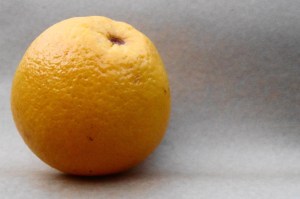
Observing Nature, we notice that an orange tree let its leaves and oranges fall on the ground. If oranges are not harvested, they will break off after a while. Leaves, peel and pulp will merge with earth and, with the help of microorganisms, will become soil’s nutrients. The seed will grow, and a new orange tree will be there, producing new oranges. This is a cycle.

An orange and its parts (peel, pulp, seed) are recyclable, and this process is conducted by Nature. No human action is needed; it will happen in an independent way. Therefore we call it self-sustainable.

In our daily lives, glass is an example of cycle. Used for thousands of years, it is a material developed by man. Today we use glass in packages, which after use, can be recycled. But human action in this cycle will always be necessary. Used glass cannot remain in the environment until it breaks off. It needs to be taken away to a recycling unit, to be molten and reused. Glass is recyclable, but this process depends on human action.

Tires are another case. Part of their raw material comes from the rubber tree. After its use, however, it is not possible to reuse this original material like we do with glass, for example. Old tires are used in new shoe products or are shredded and mixed as an ingredient of road asphalt. And this process also depends on us to be carried.

From these examples, the orange tree one is the most functional and complete. We, human beings, are challenged today to create materials and processes inspired by the self-sustaining examples of Nature. This challenge adds sense to the word s u s t a i n a b i l i t y.

Dengue, Prevention and Hope

The thirtieth:
Time to remember

Article published in June 2014

OLYMPUS DIGITAL CAMERA

To list the wonders of Nature is an easy task. It is nice to talk about the beauty of a flower, the miracle of life and the enchantment of a wave breaking on a beach.

But Nature is not only this. When we talk about the divine Creation, as described in the book of Genesis, we think of sees and mountains, plants and animals. But, what about the dengue mosquito, the Aedes aegypti, where does it fit in this theme ? Its name means “The hateful from Egypt”, perhaps as an alert about the dangers it might bring about us, humans.

Currently several brazilian cities are facing hard times, as a dengue epidemics reaches big proportions. Public campaigns constantly recommend that mosquito’s breeding points be eliminated, i.e., places that make its reproduction possible: clean water, standing in some location where the mosquito lay its eggs.

Dengue is a sickness caused by a virus and transmitted by the mosquito by means of a sting in our skin. Therefore it is important to fight the mosquito and its reproduction: if there is no mosquito there will be no sting, and without a sting, there will be no sickness. The dengue fever, as it is known, can be treated, but in some cases can lead to death.

Everyone is responsible to fight the dengue mosquito. In a time of an unprecedented urban growing, various kinds of objects, debris or spread garbage remain exposed to air and rain, and they end up by accumulating water, where the mosquito will later lay its eggs. As a conscious citizen, be always alert, and specially, if you are in a leadership position, let your actions be an example to others: strive to avoid the formation of mosquito’s breeding points.

To build dengue free urban spaces, which combine well being and respect to Nature, is a challenge in this 21st century. And at the same time, it means hope.

The Name of Things

The thirtieth:
Time to remember

Article published in May 2014

May (4)

While you walk in a street, you see a car that you have never seen before. You want to know its name, then you get closer to its rear part and see there, engraved in a tag, the model’s name.

With trees it is different. We use to know the name of some species, that are quite different among themselves: a pine tree, a palm tree or maybe a cactus. Other trees we can recognize by their fruits, like an apple tree or a mango tree.

Truth is that the amount of tree species in our planet is immense and its great majority has a similar shape. A professional who studies plants will know trees, and call them by their binomial name (scientific name). Example: Cedar of Lebanon, is called “Cedrus libani” by a botanics expert.

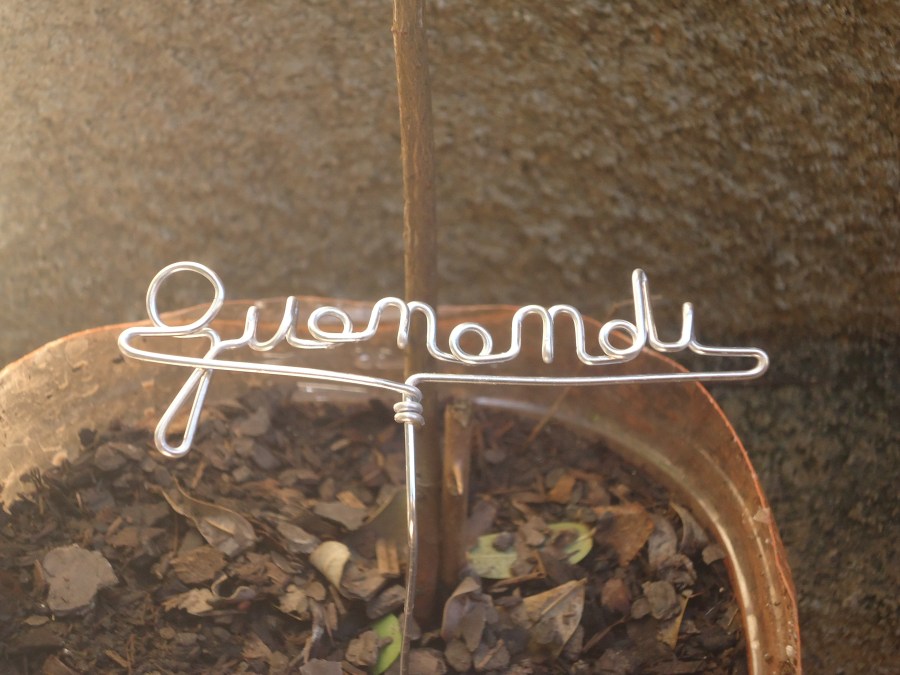
Ancient cultures assigned names to trees, which we still use nowadays and called them “popular names”. Case in point is the “Calophyllum brasiliense” (scientific name), which is popularly known in Brazil as “Guanandi” (indian name) or “Santa-Maria” (portuguese name).

It is important to know the name of something we want to protect and get to know better. A suggestion is to identify trees by writing their names in a handwritten style, by wrapping an aluminum wire. A good craftsman, using pliers, can carefully write this information for you.

You just need to put it on the ground and you will be able to read the name of a tree whenever you want to !

Tree got car dirty due to birds resting on its branches

Bird

Much attention has been given to trees when we talk about “nature” or about the “environmental issue”. That’s because when a tree is planted where no tree existed before, a cycle starts. A tree is an oxygen producing unit, a humidity stabilizer and a shelter to small animals.

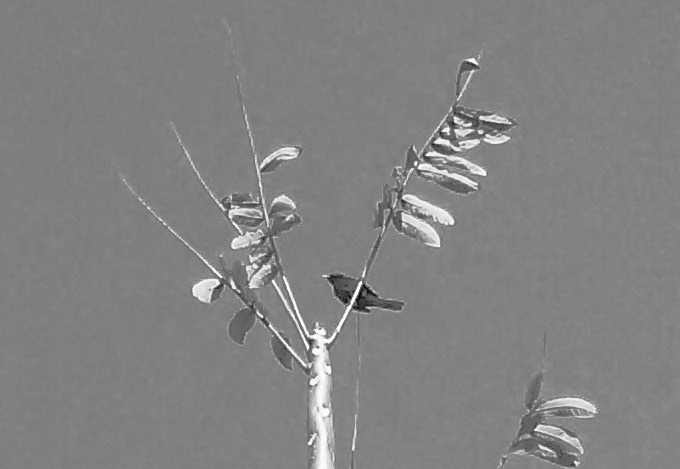
Some of them look for a tree due to its shadow (that is the case of human beings…), others search it for protection, as a refuge. Birds many times build nests, or simply rest on its branches.

The cycle continues when this tree reproduce. Another tree is born, and then, step by step, a forested area starts to grow with plants and animals around it (insects, worms, caterpillars, squirrels, etc.) We say that an ecosystem is taking shape. This process keeps going until its height, when an intense utilization of the local space and resources takes place. This stage has been historically called climax community.

These concepts are described in detail in ecology books. We decided to talk about them, because they illustrate how important a tree is in the cycle of life, here on planet Earth.

On the other hand, we understand that many people like their cars. They are practical, moving people and loads from place to place. They might be beautiful or not, and may have cost lots of sweat and work from those who own them.

When a bird resting on a tree let its manure fall on an automobile and this scratches its paint job, the bird is not doing it on purpose. Birds are part of the cycle of life in our planet, while a car is a human invention (no matter how useful or beautiful it may seem).

The awning, another human invention, is a solution to protect a car’s paint job. And compared to the price of an automobile, it is a fairly inexpensive gadget. Now, a decision needs to be taken: spend some money to buy and install a car awning ? Or cut the cycle of life represented by the tree and its birds ?  Everyone’s conscience  should decide.

Carbon and you

The thirtieth:
Time to remember

Article published in April 2014

April (4)

Few years ago, a young man asked me: “What is carbon ?”
I talked to him about carbon dioxide, graphite, coal and diamond. Then I wrote some chemical formulas with many letters “c” and showed it to him. I could see disappointment in his face…
I was talking about something really difficult to imagine.

Today I would answer that carbon is part of many things around us. It is like an ingredient that you don’t see, but you know it is there. It is part of our body, of gasoline, of ethanol fuel, of the food we eat, of the air we breath, etc.

Why people talk so much about carbon nowadays ? It is a matter of quantity. The air we breath in our planet has increasingly more carbon. This carbon was part of the oil, for example, that was once below the earth and the see. Since roughly hundred years, it started to be used by the industry and automobiles, which, by burning their derived products (gasoline, diesel, etc) throw carbon in the air. Air pollution started to increase therefore.

The problem is not carbon, but the unbalance about its quantity: in the past, it was below the soil and today it is in the air, in an excessive amount. By means of plants, Nature could solve this unbalance. Through the photosynthesis phenomenon, trees capture carbon gases from the atmosphere transforming them into oxygen gas. The problem, again, is the amount: day by day, more carbon is thrown in the planet’s atmosphere while the quantity of trees that could help to solve this problem gets shorter.

A planet made for us

The thirtieth:
Time to remember

Article published in March 2014

IM000061.JPG

Most of our planet is covered with water (oceans). Above the earth, we have the atmosphere. And the dry land (continents) is the space reserved for us, human beings. What we call “the world we live in” is a finite territory, and to a good extent, is custom made for our existence.

Part of the dry land is not liveable due to temperature extremes. The frozen land around the south pole, and other areas spread around the globe, like the Sahara, are some examples. Our body internal temperature is around 36°C. We are very sensitive to the external temperature: it affects our body’s equilibrium and our well being.

To live in the midst of the ocean is possible. Some projects of marine platforms are pointed as a solution for countries that have small territories. To live immersed in water, artificially, is also a reality. Inside a submarine, we have temperature and pressure of the earth’s surface created by equipment. But both are expensive alternatives.

In analogy to the see, to live in the atmosphere, or above it, is also possible: inside an airplane or a space station. Inside them, temperature and pressure, similar to those found in the earth’s surface is recreated, and we can also live there.

Underground cities exist in projects, to be used in case of war. Life in other planets is still a mistery to be unveiled: first, it would be necessary to find a planet with conditions similar to our Earth’s, and then, create an efficient mean of transportation to colonize it.

Nothing is better than taking care of our good old Earth. Keep the cities we live in clean and organized, reducing the amount of pollutants, replanting forests and protecting the natural sources of water. Like poets once said, our planet is unique: it is the only one…