Have you ever seen a dinosaur ?

The thirtieth:
Time to remember

Article published in August 2015

OLYMPUS DIGITAL CAMERA

Dinosaurs lived on Earth, in the same planet we live now, millions of years ago. No human being has ever seen these pre-historical animals alive. Their existence was inferred when their bones were found and later reassembled, regaining their original structure. These remains, the fossils, bear witness of a form of life that no longer exists.

The dinosaurs were extinct by a still unknown cause. Theories sustain that, long ago, a celestial body that collided with our planet caused an enormous devastation. As a result, a great part of the living beings on earth became extinct. A cosmic tragedy would have happened, without the interference of (still non existing) humans.

To modern science, extinction is a natural phenomenon. Although it has always existed, currently it occurs more frequently. And this is considered abnormal within Nature’s equilibrium system. Since the beginning of the Industrial Age, human activity imparted deep changes on our planet. Parallel to this, extinction processes became more intense.

Case in point is the passenger pigeon. Considered the most abundant bird on the planet, it has been decimated by firearms hunt and extinct in 1914. A human invention has been badly utilized against defenseless animals, in a time of incipient ecological awareness. The result of this action was a farewell to an animal species.

Nature has its processes. And the human species, steadily more powerful, interfere in these processes in a devastating manner. Consciousness and human actions of the present time will determine, in great measure, the existence of our future Nature. It is up to us, 21st century citizens, to gather maximal efforts to avoid that more forms of life cease to exist due to human mishandling.


Saving trees from extinction

The thirtieth:
Time to remember

Article published in July 2015

OLYMPUS DIGITAL CAMERA

Many people pay daily attention to a pet (little kitty, doggie, etc.). It’s very good to have their presence at home… However, considering the possible extinction of some species, have you ever imagined dedicating yourself to a panda bear, every day ?

The panda, a mammal natural from China, became a symbol of protection of threatened species, decades ago… We know that extinction is forever. It happens when an animal or plant, for example, cease to exist on Earth.

You may not have a panda at home, but you can take care of a native tree of your region and help to save it from extinction. If this proposal makes sense to you, know that a common citizen can consistently contribute to this cause, with no complications and at a low cost.

To plant a seedling and look after it, is not difficult. It may be in a public square, on the sidewalk of your house, in the backyard, or even at the balcony of an apartment. Taking care of it every day means helping it to survive possible threats (locusts, ants, drought, vandalism, etc.).

If you have ever taken care of a pet, you know what it is taking care of someone. A tree will need more attention in its first year of life.
Later, when its trunk grows thicker, it will instil respect on others by itself. Isn’t it so among us, humans, as well ?

Plant a tree and take care of it every day. It is a demonstration of love towards the divine creation, and it is at anyone’s reach.

Texts about the future Nature…

The thirtieth:
Time to remember

Article published in June 2015

OLYMPUS DIGITAL CAMERA

Since April 2016, a total of 25 reflections about this theme have been presented here, in this website.

They gave us the opportunity to review subjects learned in school, in ecology classes, or in newspapers.

In a straightforward way we went through several topics:

What is…
A biome ?
Gaia Theory ?
Sustainability ?
Biogeochemical cycle ?
Carbon in the atmosphere ?
Riding around and street riding ?

* To increase your knowledge about these subjects is a way to strive for a better future. This is the objective of this section !

* Planting a single tree, native to your region, and taking care of it every day is a very simple task. Through this action, you can help to preserve a species, saving it from extinction.

* Keeping a bicycle and using it whenever possible for transportation, will deeply benefit your health and the environment, helping to reduce the emission of pollutant gases.

Help to create the future Nature… it is not difficult. A small commitment and lots of optimism are enough to practice these three actions !

Tree was big and could fall over houses, cars, or people

Objects may fall from a variety of heights, and hurt people. The heavier the object, the stronger its force when it reaches the ground. Yes, we are talking about the Law of Gravity. Its validity applies to branches or tree trunks, and also for tiles, boards, or any sort of architectural fixture.

Another remarkable fact is that a gale or thunderstorm does not spare any object ahead, neither Nature’s nor human creation.

We want therefore state that, just for living in our planet, in a forest or in a city, we are subject to be hit by a falling object (caused by natural phenomena or not).

To keep a clean and safe environment in the cities is an honorable initiative. Nevertheless, when a hazard caused by a tree is identified, most of the times it can be resolved by pruning. Big and heavy branches may be cut without compromising the tree’s life.

The choice about what and where to plant are preventive solutions for this problem (to be adopted before it shows up). Systematic pruning is another preventive solution, to be put in practice continuously, i.e., during the growing phases of the tree.

Trees are Oxygen Producing Units (OPU) and putting them down is justified in extreme cases only. An example is when a tree is bent over a ravine and its fall is imminent. And, definitely, putting down a tree just for personal convenience is an anti-social and unacceptable attitude.

It is worth saying that the careful pruning of a tree means labor (people’s effort and costs). However, its outcome is highly compensating. Profits are: keeping the tree alive, better air quality and thermal stability.

Safety and bike riding (Part 4)

The thirtieth:
Time to remember

Article published in April 2015

Apr (2)

This fourth and last article addresses recommendations to drivers in general:


13. Consider that a biker is always in search of balance

Not everyone is able to seat on a bike and stay there without falling. In order to ride a bicycle, a person needs to balance on it. Many times, a biker cannot release her hand from the handlebar to show thankfulness for a gentle driver. In other cases, a biker could not show with an arm gesture her intention to turn to the left, for example. To release a hand from the handlebar could mean lose balance and fall to the ground. Take this always in consideration.


14. Keep distance from bikers

Asphalt holes or curls, a pool of oil, a thick layer of pebbles, a small obstacle, or even an ice layer (in places where temperature reaches 32° F or less) can make a biker fall. In streets and roads, the possibility of finding something that causes a biker to go to the ground is very high. Ironically, a biker needs space around her to fall in a safe way. Therefore, never pass too close by a biker. Keep always a reasonable distance (1 yard 2 feet or more).


15. Understand the meaning of a biker’s physical effort

A bicycle is moved by the biker’s legs: it has no motor. Therefore, when a biker is standing still and starts to move, he needs more time to reach some speed than a motorcycle, for example. And since a bike ride depends on the biker’s muscles, he could not be able to finish it due to energy failure. He will need to stop to get some nourishment and then keep going. He will always need lots of liquids and protection from excessive heat: a sunstroke, lack of water or food may cause him to faint.


16. Pay respect to spaces planned for bikers

In the 21th century, more and more streets and roads around the world are planned to accommodate automobiles. Little space is dedicated to bikers. Who rides a bicycle, has to be satisfied with few bike paths offered by some cities. A driver should pay respect to these spaces, not driving or parking on the lanes planned for bikers. A peaceful coexistence in traffic will depend on obedience to the law, good will and mutual respect between drivers and bikers.


Safety and bike riding (Part 3)

The thirtieth:
Time to remember

Article published in March 2015

Mar (2)

In this third article, we talk about facts involving bikers and pedestrians.


9. Look at your side, use your neck

When you drive a car, your vision will be limited by some blind spots in the car’s body, and you will need to use rear mirrors. When you ride a bike, you will have total vision. Use this feature in your favor. Look at both sides, move your neck always and pay attention to obstacles, objects and pedestrians around you. To use the neck’s muscles is an excellent exercise, especially for those who spend their days sitting in front of a computer.


10. Ride in vacant sidewalks

Many times it is possible for the biker to ride in sidewalks. When vacant, they are a safer place to ride than the street. Some of them have crossed grass and cement patterns or holes, and these end up to be a worse place to ride than the asphalted street. But when there are no bike paths available and when sidewalks are in good shape, they become the best option for a safe ride.


11. Keep distance and warn pedestrians

The sidewalk is the pedestrian’s place: never disregard her. When coming close, warn her whenever necessary with a soft bell ring, in order to avoid a fright. When passing beside him, keep distance and ride at the pedestrian’s speed. There is nothing worse for him than a biker than comes up from nothing and passes too close, at full speed. Besides causing the pedestrian a fright, it can make anger grow against bikers in general.


12. Don’t use earphones when riding

In many countries around the world, it is against the law to use earphones when driving. Using them while bike riding means a big risk, too: you might not tell the upcoming of other bikers, pedestrians or automobiles. Riding your bike in parks or joint bike paths, where adults, children or leashed animals walk, will demand as much attention as driving in street traffic. Therefore, use your earphones later, after arriving at your destination.

Safety and bike riding (Part 2)

The thirtieth:
Time to remember

Article published in February 2015

2018_02


In this second article, we focus the biker who rides in the cities, alone and where bike paths are not available.


5. Do not compete with cars

Keep distance from cars whenever you have to divide any space with them. Let them pass through; don’t try to compete with them. Automobiles, trucks and buses are bulky and heavy. They need space to brake or to turn in a big curve. You, biker, occupy less space, you are light and have no steel body to protect you… therefore, keep distance.


6. Ride in calm streets

Opt to ride in streets where traffic is less intense, whenever possible. Sometimes you may be riding in a heavy traffic avenue, while its parallel street is quieter. It is worth to extend the distance to ride to make it in quieter routes. This is another way to preserve safety, keeping away from automobiles. It is a defensive attitude of bike riding.


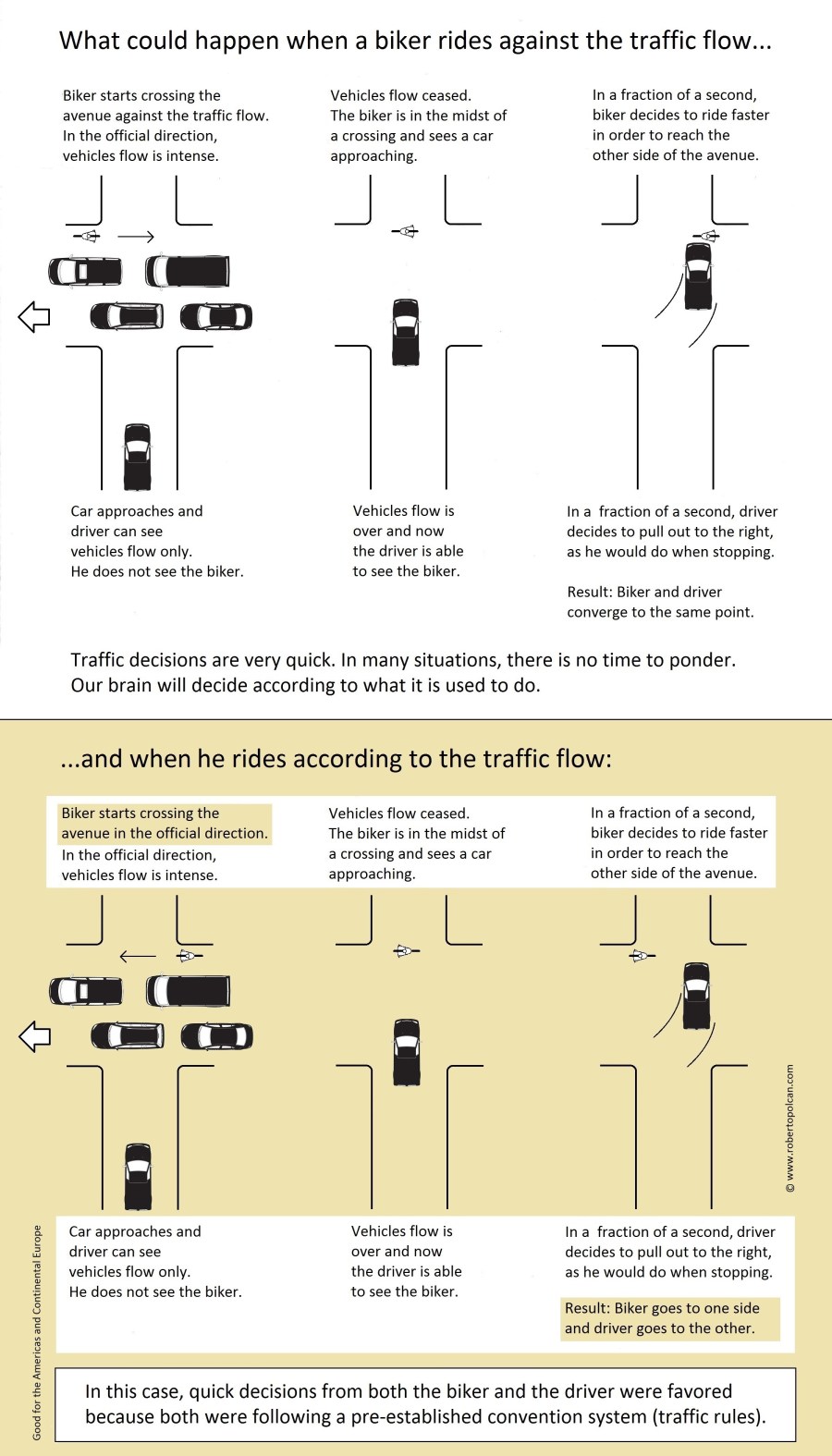
7. Ride to the traffic flow

As children, we learned about conventions on walking in the cities. As pedestrians, we learned to wait for the traffic light to close in order to cross the street. Traffic is a system of conventions between people. To ride along the traffic flow is a convention that pedestrians understand, and motorcyclists and drivers obey. To ride against the traffic flow is to break a convention, and this gives rise to confusion on people’s mind when taking decisions. Let your intentions be undoubted when riding: always ride along the traffic flow, for your safety.


8. Use warning lights at night

To ride in a street in the dark and recognize a figure just when coming close, is like getting a fright. Who travels at night in a public route must use red safety lights, whether it is a truck, a car, a motorcycle or a bicycle. The back warning light is recognized at a distance and allows sufficient time for the driver to divert. Do no take a risk. When riding at night, always turn your back light on.

Safety and bike riding (Part 1)

The thirtieth:
Time to remember

Article published in January 2015

2018_01


In 2018, we will be presenting four articles about biker’s safety. From January to April, four recommendations will be published each month. The first twelve are for those who ride bicycles and the last four are for car drivers.


1. Get on and off your bike as many times as necessary

Keeping away from comfort is the number one rule for the cautious biker. In most cities there are no special lanes for bikers. She will have to use improvised ways, cross streets where sidewalks have no slope, etc. Never take a risk, trying easy but dangerous maneuvers: get off your bike and walk a bit, in complete safety, however.


2. Wear a helmet

A bike has neither body nor bumpers, and stays upright only if the biker is able to keep its balance. The helmet will protect your head in a collision, always wear it. It will also be a sign for pedestrians and motorists that you are a responsible biker, and they will tend to show more respect to you.


3. Wear light colored clothes when is dark (be seen)

Early in the morning or in the evening, at night or when it is raining, traffic visibility gets poor. Who rides a bike needs to be seen by drivers and a simple, but very efficient way, is to use a light colored shirt. Or a coat, jacket, etc. White color, yellow, bold orange, or any other color that will make the biker recognizable at a distance.


4. Use the ringer when approaching (be heard)

Differently from a motorcycle or a car, whose purr tells you they are coming, a bicycle moves silently. If you notice that your arrival was not perceived and that it could create a risky situation, do a short “ring-ring”. It is a courtesy and will save from a fright pedestrians who walk in bike paths and also other bikers, especially when you come from behind or from the sides.

Trees together were a hiding place for thieves

This is the fifth text about alleged reasons to put down trees in urban areas. The objective of the present texts (a total of twelve) is to throw some light in this issue, avoiding the choice for the easiest way to solve problems: take a tree’s life.

Trees are Oxygen Producing Units (OPU), they are living beings, and their presence close to human populations is a standard of living rate. It is always good to remember that their absence could lead to the desertification of a whole region.

In the previous text, we talked about trees covering up an architectural work. When using trees as a hideout, someone does it, because a tree is covering him up. The concept of “covering up a view to humans” is a common fact among trees (especially if many) and an unfortunate excuse to put them down. See some examples:

* A highway administrator does not allow trees along the roads, because they might cover up the view to cameras or satellites.
* In war operations, armies use defoliators on forests, arguing that under the top of the trees, enemy troops could be hiding.
* In tree-lined streets, rapidly growing branches cover up traffic signs, especially during the summer.

Public safety is important, and, absolutely, none wants to stay close to a hideout of thieves. Pruning bigger branches could be a solution, in many cases. It does not kill the tree and makes it “cover up” a little less what we want to see. Another solution, laborious, though, would be replanting the trees in another area.

The question goes deeper, however. It is difficult to offer solutions, in a simple text like this, to chronic social problems such as criminality, war or bad will. Once again, it will be the individual and collective consciousness to decide the trees’ destiny. Trees don’t have a way to defend from human conduct.