Tree “dirtied” the sidewalk with leaves, branches, seeds and fruits_2nd vision

Our web site aims to find solutions, so that trees living in urban environments do not be cut down unnecessarily. The text presented last December pointed out an idealistic solution to keep fruit-bearing trees in the cities, saying that gathering leaves, branches, seeds and fruits from the ground is a privilege given to good will and conscious people.

Obviously this is just one side of the question. There are other points that we could discuss here, therefore this text is called “2nd vision”. With good reason, a reader made a comment on December’s text, stating that “if fruits are not gathered from the ground, they will become nourishment, especially to rats!”

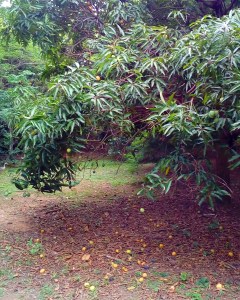
Let us go to the facts: in nature, a fruit-bearing tree let its fruits fall on the soil, and these will serve, among other things, as food for wild animals. Birds, squirrels and other rodents will be benefited from the fruits. The picture below shows a mango tree in the woods. Note how many fruits are splattered over the ground, during the spring and summer seasons.
a

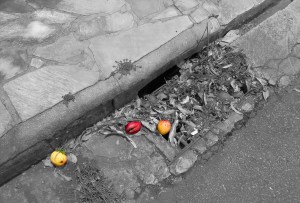
If we plant a tree of this species (mango tree) in a sidewalk, the fact will repeat itself. In the warm seasons, fruits will fall on the ground in a plentiful manner, if not harvested before. Fruits in sidewalks roll over when they fall, and move rapidly by the action of wind and rain. They may clog drains and prevent rain waters of being collected by the subterranean pipework, and flooding can happen therefore. See below the photo of a drain covered by leaves and fruits.
b

Note that the mangos, enhanced with colors in the photo, are splitting. If nobody takes them from the sidewalk, they might serve as food to rats, which are commonly found in cities and are capable of transmitting diseases to us, human beings. We have raised, therefore, two important urban problems: flooding and rodents proliferation. Now let us analyze suitable solutions.
c

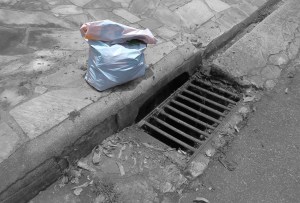
To sweep streets and put leaves and fruits in plastic bags is an immediate solution. See in the picture above how a clean drain looks like. See the bag with all the gathered material that was on and around the drain.

Remembering the reader’s comment that “good sense is necessary when planting a tree”, we can propose two more solutions. First is not to plant fruit-bearing trees in urban sidewalks, but in suitable places (parks or planned gardens).

Another initiative is to choose suitable species for urban environments before planting. For already existing fruit-bearing trees, a constant maintenance is absolutely necessary. It is not fair to plant a tree in an environment created by men, for men’s use (cities) and later hand this tree to the care of “Mother Nature”.
d

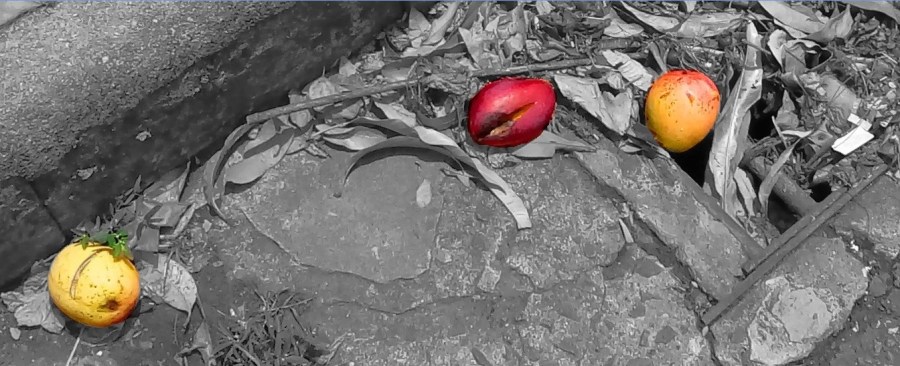
It is a pity to see delicious fruits like these ones in the photo, just thrown on the ground. An urban harvesting program, efficiently handled is another proposal to solve this problem. Volunteer groups or paid businesses could do a systematic harvesting job, to calendar. This would meet the commitment to keep the urban environment clean and at the same time protect trees from being unnecessarily cut down.
Tree “dirtied” the sidewalk with leaves, branches, seeds and fruits

5
Before coming here, we, the leaves, produced lots of oxygen for you to breathe !

To live means: to get nourished, to rest and to take care of our health and personal hygiene. These are the human bare necessities ! All the remaining activities (work, study, entertainment, etc.) come right after these basic needs were satisfied.

Personal hygiene is a very important issue in our lives. We know that if we don’t wash our hands before eating, we might get sick. If we don’t wash our body, we might get skin problems. If we don’t use deodorant, we risk smelling bad and bothering other people.

Another aspect of our personal hygiene are the clothes we wear. Dirty clothes may raise health problems, too. Then comes bed linen, followed by the room and house where we live. If they are not constantly cleaned, we risk getting sick. Example is the dust left on furniture, which can raise breathing problems.

When we get out of our home, our hygiene guidelines start to judge other places: public means of transportation, squares, streets and sidewalks. We could say “the bus was clean”, or “the square was dirty: empty packages were spread on the ground”. But, what about streets and sidewalks ? What make them dirty or clean ?

This is the point. Trees let leaves and branches, seeds and fruits fall on the ground. According to our hygiene habits applied at home, these items would be “filth” to be swept, put in bags and brought far away. If we keep thinking like this, it’s better not to have trees around. Hygiene is costly, why then have such additional work ?

Trees, however, have the right to exist and are necessary to our survival. Leaves on the ground are not filth. They are evidence that a tree generated oxygen for you to live. While gathering leaves, branches, seeds and fruits you will be valuing life itself. Don’t see it as an annoyance, but as a privilege given to good will and conscious people !

Tree did interfere with electric wiring


09_September (7)


The use of electricity by human beings is a recent phenomenon. In the year 1801, Alessandro Volta presented to Napoleon Bonaparte his invention, a rudimentary electric battery. Since then, electricity and its applications did revolutionize the way we live.

Meanwhile, cities grew and became more and more complex. And to benefit from this technological advantage, an electric current distribution network was created. This happened initially by means of wires hanging on poles and later by subterranean cables.

It is difficult to imagine a city without electricity, and also a city without trees. We need both for our well-being. The systematic pruning of large size trees in urban areas may be a solution when electric cables interfere with tree branches.

Planned planting, by choosing a proper place and species, so trees do not interfere with the wiring, is also a feasible and positive attitude. Another possibility is the creation of exclusive spaces for trees (urban fields) and another space for wirings (subterranean cables or planned poles, which do not interact with branches).

Put these ideas to practice ? To do this, a major awareness effort must take place, towards municipal authorities and common citizens. Pruning trees means work, and dedicating urban grounds to trees or changing to subterranean cables involve high costs. Nevertheless, the results would bring an incomparable lift in the quality of life of a city.


Trees have the right to exist

Putting down trees in urban areas is still usual in the 21st Century. See some alleged reasons for cutting trees (by those who did it):

“I put down a tree because…

  1. It did interfere with a hanging electric wiring
  2. It made the sidewalks dirty with branches, seeds and fruits
  3. Birds harmed the paint of cars parked under it
  4. The vision of a building, an architectural work, was hidden
  5. Many of them together were a hiding place for thieves
  6. It was big, it could fall over houses, cars, or people
  7. It was a hassle to prune it, and I had no time to do it
  8. It would decrease the value of a for-sale real estate
  9. It occupied too much space in the sidewalk
  10. It was not a native tree
  11. It was old
  12. I didn’t like trees

As we talk about cutting and killing trees in the cities, it is time to break paradigms (stop believing in explanations given in the past, about a reality that no longer exists and start trusting new explanations, more consistent with today’s real world).

Remarkable fact nowadays are the climate changes. Scientific authorities state that 2016 will be the hottest year in the world’s recent history. And the amount of carbon thrown everyday in the atmosphere is still high and at non satisfactory levels worldwide.

Trees offer a local solution for both problems: they provide thermal stability, remove carbon from the atmosphere and give it back the precious oxygen.

Trees are therefore necessary, especially in urban areas ! To break paradigms, then, is to accept that the human race NEEDS trees to survive. It means also the proposal of new solutions, both feasible and rational, to problems that trees might create.

In the forthcoming weeks, we will analyze each reason given by those who have been removing trees in urban areas and point out possible solutions to each case.