Dengue, Prevention and Hope

The thirtieth:
Time to remember

Article published in June 2014
OLYMPUS DIGITAL CAMERA

To list the wonders of Nature is an easy task. It is nice to talk about the beauty of a flower, the miracle of life and the enchantment of a wave breaking on a beach.

But Nature is not only this. When we talk about the divine Creation, as described in the book of Genesis, we think of sees and mountains, plants and animals. But, what about the dengue mosquito, the Aedes aegypti, where does it fit in this theme ? Its name means “The hateful from Egypt”, perhaps as an alert about the dangers it might bring about us, humans.

Currently several brazilian cities are facing hard times, as a dengue epidemics reaches big proportions. Public campaigns constantly recommend that mosquito’s breeding points be eliminated, i.e., places that make its reproduction possible: clean water, standing in some location where the mosquito lay its eggs.

Dengue is a sickness caused by a virus and transmitted by the mosquito by means of a sting in our skin. Therefore it is important to fight the mosquito and its reproduction: if there is no mosquito there will be no sting, and without a sting, there will be no sickness. The dengue fever, as it is known, can be treated, but in some cases can lead to death.

Everyone is responsible to fight the dengue mosquito. In a time of an unprecedented urban growing, various kinds of objects, debris or spread garbage remain exposed to air and rain, and they end up by accumulating water, where the mosquito will later lay its eggs. As a conscious citizen, be always alert, and specially, if you are in a leadership position, let your actions be an example to others: strive to avoid the formation of mosquito’s breeding points.

To build dengue free urban spaces, which combine well being and respect to Nature, is a challenge in this 21st century. And at the same time, it means hope.
The Name of Things

The thirtieth:
Time to remember

Article published in May 2014

May (4)

While you walk in a street, you see a car that you have never seen before. You want to know its name, then you get closer to its rear part and see there, engraved in a tag, the model’s name.

With trees it is different. We use to know the name of some species, that are quite different among themselves: a pine tree, a palm tree or maybe a cactus. Other trees we can recognize by their fruits, like an apple tree or a mango tree.

Truth is that the amount of tree species in our planet is immense and its great majority has a similar shape. A professional who studies plants will know trees, and call them by their binomial name (scientific name). Example: Cedar of Lebanon, is called “Cedrus libani” by a botanics expert.

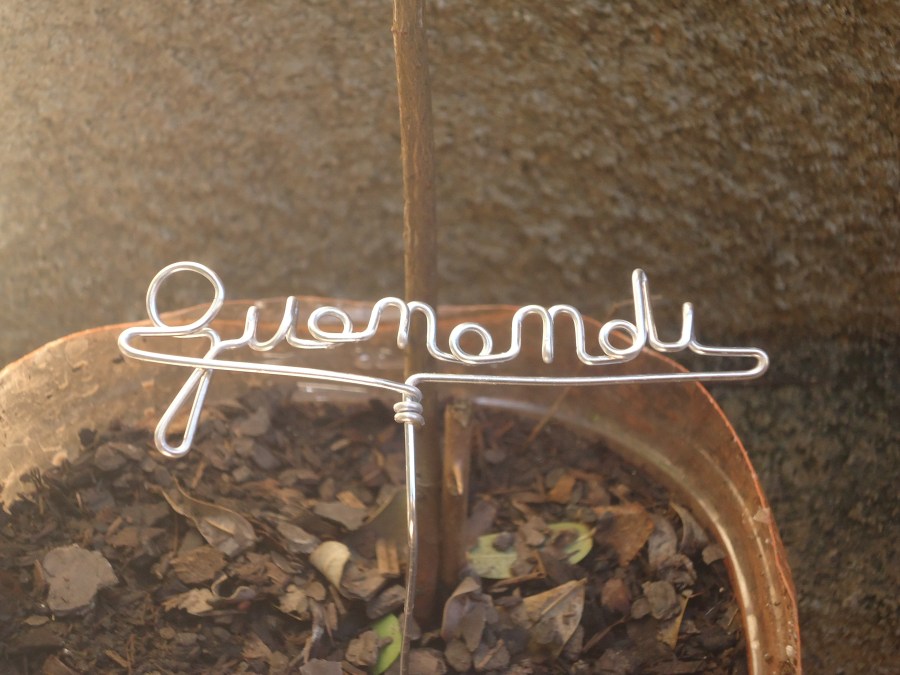
Ancient cultures assigned names to trees, which we still use nowadays and called them “popular names”. Case in point is the “Calophyllum brasiliense” (scientific name), which is popularly known in Brazil as “Guanandi” (indian name) or “Santa-Maria” (portuguese name).

It is important to know the name of something we want to protect and get to know better. A suggestion is to identify trees by writing their names in a handwritten style, by wrapping an aluminum wire. A good craftsman, using pliers, can carefully write this information for you.

You just need to put it on the ground and you will be able to read the name of a tree whenever you want to !

Carbon and you

The thirtieth:
Time to remember

Article published in April 2014

April (4)

Few years ago, a young man asked me: “What is carbon ?”
I talked to him about carbon dioxide, graphite, coal and diamond. Then I wrote some chemical formulas with many letters “c” and showed it to him. I could see disappointment in his face…
I was talking about something really difficult to imagine.

Today I would answer that carbon is part of many things around us. It is like an ingredient that you don’t see, but you know it is there. It is part of our body, of gasoline, of ethanol fuel, of the food we eat, of the air we breath, etc.

Why people talk so much about carbon nowadays ? It is a matter of quantity. The air we breath in our planet has increasingly more carbon. This carbon was part of the oil, for example, that was once below the earth and the see. Since roughly hundred years, it started to be used by the industry and automobiles, which, by burning their derived products (gasoline, diesel, etc) throw carbon in the air. Air pollution started to increase therefore.

The problem is not carbon, but the unbalance about its quantity: in the past, it was below the soil and today it is in the air, in an excessive amount. By means of plants, Nature could solve this unbalance. Through the photosynthesis phenomenon, trees capture carbon gases from the atmosphere transforming them into oxygen gas. The problem, again, is the amount: day by day, more carbon is thrown in the planet’s atmosphere while the quantity of trees that could help to solve this problem gets shorter.

A planet made for us

The thirtieth:
Time to remember

Article published in March 2014

IM000061.JPG

Most of our planet is covered with water (oceans). Above the earth, we have the atmosphere. And the dry land (continents) is the space reserved for us, human beings. What we call “the world we live in” is a finite territory, and to a good extent, is custom made for our existence.

Part of the dry land is not liveable due to temperature extremes. The frozen land around the south pole, and other areas spread around the globe, like the Sahara, are some examples. Our body internal temperature is around 36°C. We are very sensitive to the external temperature: it affects our body’s equilibrium and our well being.

To live in the midst of the ocean is possible. Some projects of marine platforms are pointed as a solution for countries that have small territories. To live immersed in water, artificially, is also a reality. Inside a submarine, we have temperature and pressure of the earth’s surface created by equipment. But both are expensive alternatives.

In analogy to the see, to live in the atmosphere, or above it, is also possible: inside an airplane or a space station. Inside them, temperature and pressure, similar to those found in the earth’s surface is recreated, and we can also live there.

Underground cities exist in projects, to be used in case of war. Life in other planets is still a mistery to be unveiled: first, it would be necessary to find a planet with conditions similar to our Earth’s, and then, create an efficient mean of transportation to colonize it.

Nothing is better than taking care of our good old Earth. Keep the cities we live in clean and organized, reducing the amount of pollutants, replanting forests and protecting the natural sources of water. Like poets once said, our planet is unique: it is the only one…

Material world and living world

The thirtieth:
Time to remember

Article published in February 2014

02_feb-4

In some place, we living beings dwell.
We need a space to live in the material world. Let us consider some examples:

1.The atmosphere is the place where birds spend part of their time, and where many microorganisms live permanently.

2.Among the rocks, live several kinds of spiders

3.In the sand, crabs live. They spend their days in holes or moving side to side.

4. In the seawater, live many species of fish, plants, microorganisms and even the biggest mammal, the whale.

The list continues, but remember that these are material spaces (air, water, rocks, sand, etc.). However, in their materiality, they offer conditions that make like possible.

It is the case of the atmosphere. In the primordial times of our planet, it had no oxygen. Primitive forms of life enriched our atmosphere with this gas, allowing the existence of more developed forms of life, including ours.

Our material world is thus different than that one in Mars, despite many similarities between the two planets.

This is the base of the Gaia Theory: primitive forms of life transforming the material space of a planet in order to make possible the existence of more developed forms of life.


New year, new attitudes

The thirtieth:
Time to remember

Article published in January 2014 (adapted to 2017…)

OLYMPUS DIGITAL CAMERA

New year, new attitudes.
A year is gone, a new year is beginning.

What about planting a tree in 2017 ? Besides enlarging the green area of your city, you will breathe a cleaner air. Imagine that in 2023 you will be able to seat under its shadow… Isn’t it a wonderful motivation ?

Take trash recycling seriously. Encourage other people to do it, especially those who are unaware of its benefits. There is nothing worse to the cities or to Nature than litter out of its place !

Walk more and ride your bike, also for small shopping. There will be benefits for your health and for your pocket, besides saving some gas and polluting less the atmosphere.

A 2017 plenty of small accomplishments like these could turn it into one of the happiest years of our lives !! Happy 2017 !!

Nature and Time

The thirtieth:
Time to remember

Article published in December 2013:

A baby is born and takes 15 years to reach an adult’s height. When a puppy dog is born, it takes roughly 15 months to look like an adult dog. Time goes by to everyone, in the same way… however each species of the animal kingdom answers in a different way.

Among trees happens the same thing. While an avocado tree grows rapidly in its first years of life, a brazil wood tree shows a much slower growth in the same period.

This could be a motivation not to plant it and to chose a tree with a faster growth rate, instead. With this option, endangered species (which is the case of the brazil wood tree) have more difficulty to recover the space they had in the past, and remain under threat.

Let us re-think our attitude when we plant… Let us remember that time acquires different dimensions to the living beings: wheter a bacterium, a puppy dog, we, human beings or the various species of plants and trees.

IM000423.JPG

Nature and her rules

The thirtieth:
Time to remember

Let us remember that Nature also has her rules !
Article published in November 2013:

For us she is Mother Nature, and we all know, she does not issue environmental conformity certificates. Neither recognizes governments nor borders between countries. That’s because Nature has its own rules, which are supreme. One of them is to restore itself. When not touched by humans, Nature tends to a self-restoring equilibrium. Case in point are cities of ancient civilizations which were abandoned long ago. Centuries later, they were found covered by plants. Nature just does it. And, in the absence of human interference, nature exists in its primitive state.

nature-7

One word, two concepts

The thirtieth:
Time to remember

Article published in October 2013:

Imagine a campfire burning dried branches of wood to warm a soup vessel. This scene, so common to our ancestors, describes the use of “biomass as a fuel”. In this case, the dried branches are the biomass, and burning them means utilize branches of wood as a fuel.

Now imagine a forest and their trees, animals, fungi, microorganisms and bacteria. This means, the total quantity of anything who bears life. This total quantity, which can be measured, is also called biomass. And it can be measured separately (animals only, plants only, etc.).

When you read articles in newspapers and magazines, you will identify by context in what sense this word is being used. A single word holds two concepts: related but different, however.

2013_oct_1

Why trees don’t walk

The thirtieth:
Time to remember

Let us remember why trees don’t walk !
Article published in September 2013:

OLYMPUS DIGITAL CAMERA

Trees produce oxygen and need lots of water to accomplish this task. They act as a lab, that processes a chemical reaction (photosynthesis), where the input substances are carbon dioxide and water and the output substances are carbohydrate and oxygen.

In order to have plenty of water, their roots are below the earth, where they get the necessary amount of water. This make them different from animals (and from us, humans), those who do not produce oxygen. Since we need less water than trees, we don’t need to be always attached to the earth. We are portable, we take in our body the water we need.

Trees do also breath like we do (they take oxygen from the air and give back carbon dioxide), but in parallel they produce oxygen in the presence of sunlight. When you water your tree, always remember that it will give us back its best: oxygen for us to breath.