Riding a Bicycle

Site em Português

From January to May 2018, we published five articles on this website about cycling (originally published in 2015).

Titled
-Safety and bike riding (Parts 1 to 4)
-Traffic flow: To follow or not to follow
These articles are available below, with photos and diagrams.
Simply scroll or search by date or title !

In this month of August 2025, we publish “Safety and bike riding” in a new format. Let’s go to it:

Safety and bike riding

12 recommendations for those who ride bicycles and 4 for car drivers.

For those who ride a bicycle, whether child or adult:

  1. Get on and off your bike as many times as necessary

Keeping away from comfort is the number one rule for the cautious biker. In most cities there are no special lanes for bikers. She will have to use improvised ways, cross streets where sidewalks have no slope, etc. Never take a risk, trying easy but dangerous maneuvers: get off your bike and walk a bit, in complete safety, however.

  1. Wear a helmet

A bike has neither body nor bumpers, and stays upright only if the biker is able to keep its balance. The helmet will protect your head in a collision, always wear it. It will also be a sign for pedestrians and motorists that you are a responsible biker, and they will tend to show more respect to you.

  1. Wear light colored clothes when is dark (be seen)

Early in the morning or in the evening, at night or when it is raining, traffic visibility gets poor. Who rides a bike needs to be seen by drivers and a simple, but very efficient way, is to use a light colored shirt. Or a coat, jacket, etc. White color, yellow, bold orange, or any other color that will make the biker recognizable at a distance.

  1. Use the ringer when approaching (be heard)

Differently from a motorcycle or a car, whose purr tells you they are coming, a bicycle moves silently. If you notice that your arrival was not perceived and that it could create a risky situation, do a short “ring-ring”. It is a courtesy and will save from a fright pedestrians who walk in bike paths and also other bikers, especially when you come from behind or from the sides.

To the biker who rides in the cities, alone and where bike paths are not available:

  1. Do not compete with cars

Keep distance from cars whenever you have to divide any space with them. Let them pass through; don’t try to compete with them. Automobiles, trucks and buses are bulky and heavy. They need space to brake or to turn in a big curve. You, biker, occupy less space, you are light and have no steel body to protect you… therefore, keep distance.

  1. Ride in calm streets

Opt to ride in streets where traffic is less intense, whenever possible. Sometimes you may be riding in a heavy traffic avenue, while its parallel street is quieter. It is worth to extend the distance to ride to make it in quieter routes. This is another way to preserve safety, keeping away from automobiles. It is a defensive attitude of bike riding.

  1. Ride to the traffic flow

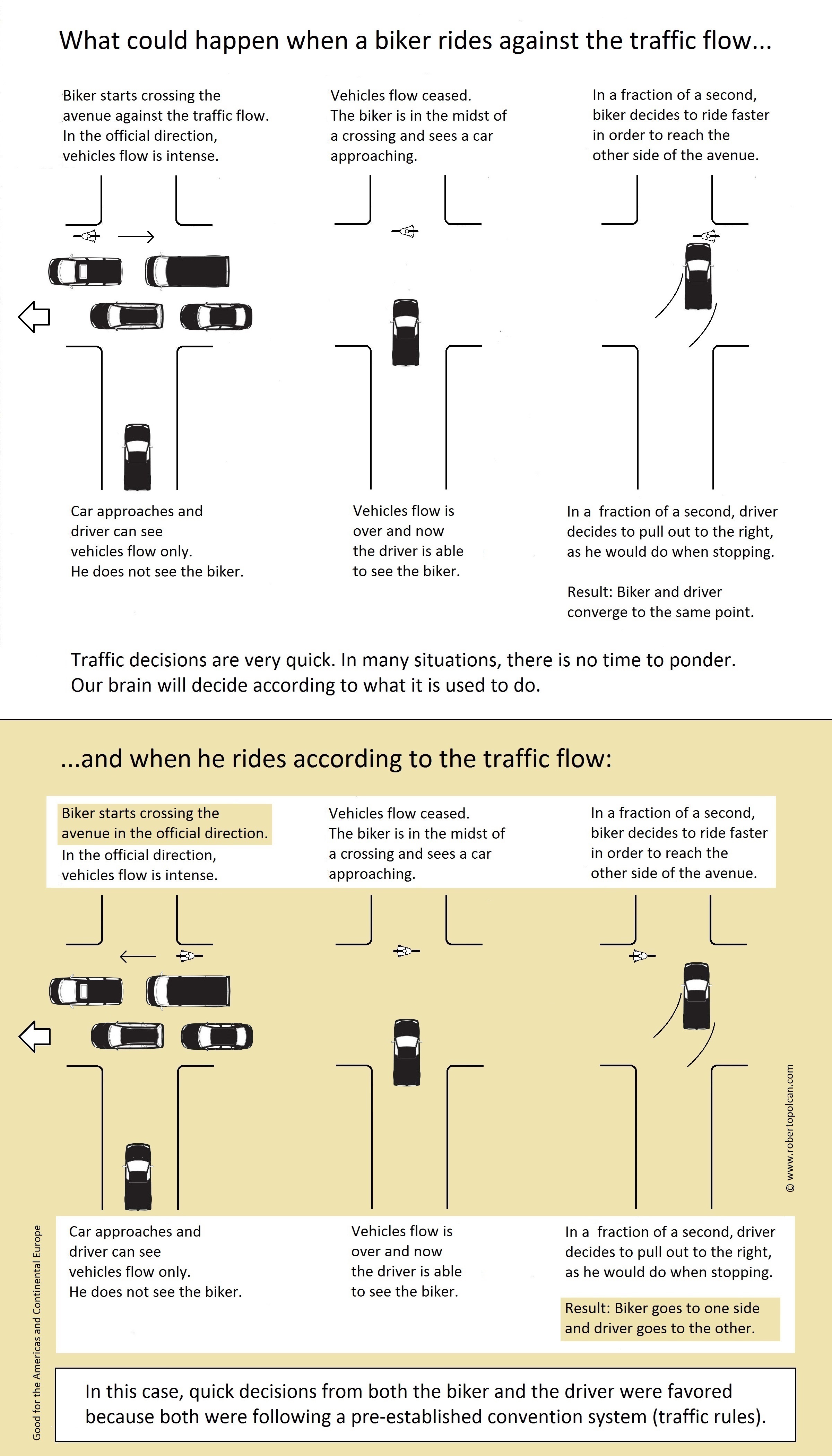
As children, we learned about conventions on walking in the cities. As pedestrians, we learned to wait for the traffic light to close in order to cross the street. Traffic is a system of conventions between people. To ride along the traffic flow is a convention that pedestrians understand, and motorcyclists and drivers obey. To ride against the traffic flow is to break a convention, and this gives rise to confusion on people’s mind when taking decisions. Let your intentions be undoubted when riding: always ride along the traffic flow, for your safety.

  1. Use warning lights at night

To ride in a street in the dark and recognize a figure just when coming close, is like getting a fright. Who travels at night in a public route must use red safety lights, whether it is a truck, a car, a motorcycle or a bicycle. The back warning light is recognized at a distance and allows sufficient time for the driver to divert. Do no take a risk. When riding at night, always turn your back light on.

Facts involving bikers and pedestrians:

  1. Look at your side, use your neck

When you drive a car, your vision will be limited by some blind spots in the car’s body, and you will need to use rear mirrors. When you ride a bike, you will have total vision. Use this feature in your favor. Look at both sides, move your neck always and pay attention to obstacles, objects and pedestrians around you. To use the neck’s muscles is an excellent exercise, especially for those who spend their days sitting in front of a computer.

  1. Ride in vacant sidewalks

Many times it is possible for the biker to ride in sidewalks. When vacant, they are a safer place to ride than the street. Some of them have crossed grass and cement patterns or holes, and these end up to be a worse place to ride than the asphalted street. But when there are no bike paths available and when sidewalks are in good shape, they become the best option for a safe ride.

  1. Keep distance and warn pedestrians

The sidewalk is the pedestrian’s place: never disregard her. When coming close, warn her whenever necessary with a soft bell ring, in order to avoid a fright. When passing beside him, keep distance and ride at the pedestrian’s speed. There is nothing worse for him than a biker than comes up from nothing and passes too close, at full speed. Besides causing the pedestrian a fright, it can make anger grow against bikers in general.

  1. Don’t use earphones when riding

In many countries around the world, it is against the law to use earphones when driving. Using them while bike riding means a big risk, too: you might not tell the upcoming of other bikers, pedestrians or automobiles. Riding your bike in parks or joint bike paths, where adults, children or leashed animals walk, will demand as much attention as driving in street traffic. Therefore, use your earphones later, after arriving at your destination.

Recommendations to drivers in general:

  1. Consider that a biker is always in search of balance

Not everyone is able to seat on a bike and stay there without falling. In order to ride a bicycle, a person needs to balance on it. Many times, a biker cannot release her hand from the handlebar to show thankfulness for a gentle driver. In other cases, a biker could not show with an arm gesture her intention to turn to the left, for example. To release a hand from the handlebar could mean lose balance and fall to the ground. Take this always in consideration.

  1. Keep distance from bikers

Asphalt holes or curls, a pool of oil, a thick layer of pebbles, a small obstacle, or even an ice layer (in places where temperature reaches 32° F or less) can make a biker fall. In streets and roads, the possibility of finding something that causes a biker to go to the ground is very high. Ironically, a biker needs space around her to fall in a safe way. Therefore, never pass too close by a biker. Keep always a reasonable distance (1 yard 2 feet or more).

  1. Understand the meaning of a biker’s physical effort

A bicycle is moved by the biker’s legs: it has no motor. Therefore, when a biker is standing still and starts to move, he needs more time to reach some speed than a motorcycle, for example. And since a bike ride depends on the biker’s muscles, he could not be able to finish it due to energy failure. He will need to stop to get some nourishment and then keep going. He will always need lots of liquids and protection from excessive heat: a sunstroke, lack of water or food may cause him to faint.

  1. Pay respect to spaces planned for bikers

In the 21th century, more and more streets and roads around the world are planned to accommodate automobiles. Little space is dedicated to bikers. Who rides a bicycle, has to be satisfied with few bike paths offered by some cities. A driver should pay respect to these spaces, not driving or parking on the lanes planned for bikers. A peaceful coexistence in traffic will depend on obedience to the law, good will and mutual respect between drivers and bikers.

Mother Nature counts on you !

After 30 presented texts, the section
“The thirtieth: Time to remember”
says its farewell to the reader in this month of December 2018.

To you, who followed this section, congratulations !
You had the opportunity to get in contact with the basics of the environmental issue in the 21st Century.

For those who are new with these texts, they are an invitation for more knowledge. The basic presented stuff will give you a clearer understanding, when following the environmental headlines on newspaper, TV or Internet.

Remember that the international community and the newly elected Brazilian government are announcing changes related to the Amazon region for 2019. Follow the news on this biome, show to others your opinion about and interact!

Be proactive: Mother Nature counts on you !

Our friends, the animals

The thirtieth:
Time to remember

Article published in December 2015

In December, we can see many christmas trees and cribs around the city. The pine tree, as christmas tree, is a symbol of life. It keeps its leaves, which remain green, while other trees lose their leaves. This tradition definetely makes sense in the northern hemisphere, where winters are harsh and the landscape is covered by snow.

The nativity scene shows us the newborn Jesus lying on a manger. Around him we see his parents, the three Magi and several animals. Since there was no more room for guests in the inn, his birth took place in the stable, among cows, sheeps, horses and donkeys.

Christmas tree and crib, two symbols of the western culture, are signs of our proximity to Nature. We, human beings, are part of Nature, but sometimes we forget about it. In the beginning of the 21st century, to many people, this keen coexistence with animals seems to be something distant, to be found in books and ancient stories.

Just hundred years ago, the automobile was in its beginning. At that time, horses were part of our daily lives. Pulling carts and carriages, they were the principal mean of transportation in the cities. They had names and nicknames, and needed our proximity to live. Someone had to feed, wash and treat them, with deserved attention and affection.

Technology brought us countless benefits, no doubt about it. Nowadays many people live among machines, a good portion of time: computers, mobile phones, cars and lawnmowers. We became more distant to animals and, who knows, our world became colder therefore. Let us rewarm our hearts during this Christmas season, celebrating with neighbors and our friends of Nature, plants and animals !

How shall we be remembered

The thirtieth:
Time to remember

Article published in November 2015

OLYMPUS DIGITAL CAMERA

Every year, on November 2nd, millions of people around the world, pay tribute to their forefathers. They pray, visit churches or cemeteries, in some way trying to revive the memory of those who left us.

Activate good memories is part of life and it encourages us in our daily journeys. To remember a grandmother’s good advice, or great grandpa’s wise words makes us feel their presence again.

Someday, we will join those who left us. Our whole generation will vanish from the Earth’s crust… And how shall we be remembered
in the future ? What kind of image of ourselves will we leave ?
See here two possibilities:

“The late 20th and early 21st century generation used up non-renewable resources (oil and minerals) from the planet, not paying attention to those coming after. They created the greenhouse effect with their unquenchable consumption habits. Their legacy was the global warming process and its consequent ruins”.

“Despite having spread a development culture responsible for the global warming, the late 20th and early 21st century generation has recognized being victim of their own evil deeds. They established, however, a new awareness and a change in attitude about the environment, plants and animals. Along with these, the return to balance could at least start”.

Life is made up of choices… and we will be remembered by the choices we have made.

Women, family and Nature

The thirtieth:
Time to remember

Article published in October 2015

OLYMPUS DIGITAL CAMERA

There has been a lot of talk about woman’s role in the last decades. Equal rights in the job market, sharing household tasks, raise in family income and so forth. As a result, changes in society and in the economy started to happen.

A remarkable fact is that women’s empowerment walked side by side with higher purchasing power and goods consumption in developed societies. But… to leverage consumerism… would this be the fate reserved for women in the 21st century ?

A woman’s action may have a wide reach. Alone, or as part of a couple. As a child’s mother, while educating and passing her values, and in society, where feminine presence represents almost half of the population. In brief, aware about this or not, a woman is very strong.

In current days, feminine actions could strengthen the environmental cause. It is enough to say that we live times of dramatic climate changes, pollution and urban decay, and reduction of areas dedicated to wild plants and animals. Wouldn’t be this the moment to reconsider women’s action as a force to defend Nature ?

Women can do a lot about environmental preservation. Women and men united, may do even more: acting together they have an extraordinary power. As parents and mentors of a family, they may pass their values of respect for plants and animals to their children. And a proposal of defending divine creation may spring up this way as well… and spread all over the world.

4 reasons for not having a place to live

The thirtieth:
Time to remember

Article published in September 2015

OLYMPUS DIGITAL CAMERA

Reduction of areas occupied by forests
Increase of areas occupied by cities
Increase of areas occupied by agriculture
Increase of areas facing climate change problems

Due to these factors, who remains without a place to dwell and live are wild animals and plants.

With nowadays population and economic growth, where once forests flourished, cities are being built. To feed its new inhabitants, more and more agriculture fields are necessary.

With less forest area, and more CO2 emission, many areas around the globe experience temperature raise. As a consequence, the melting of icecaps occurs, which is home for the polar bear, for example. His existence remains therefore threatened.

In short, animals that used to live in their natural habitat are forced to escape and live an unprotected and fragile existence, exposed to illnesses and hunger. Not finding a place to live, they risk death and extinction.

Think big. Help to break this cycle and create new forests, urban or rural ones. Start planting a tree and taking care of it. With this action, a small portion of our planet will improve: as an immediate result, there will be a new home for birds, more thermal stability and better quality air.

Have you ever seen a dinosaur ?

The thirtieth:
Time to remember

Article published in August 2015

OLYMPUS DIGITAL CAMERA

Dinosaurs lived on Earth, in the same planet we live now, millions of years ago. No human being has ever seen these pre-historical animals alive. Their existence was inferred when their bones were found and later reassembled, regaining their original structure. These remains, the fossils, bear witness of a form of life that no longer exists.

The dinosaurs were extinct by a still unknown cause. Theories sustain that, long ago, a celestial body that collided with our planet caused an enormous devastation. As a result, a great part of the living beings on earth became extinct. A cosmic tragedy would have happened, without the interference of (still non existing) humans.

To modern science, extinction is a natural phenomenon. Although it has always existed, currently it occurs more frequently. And this is considered abnormal within Nature’s equilibrium system. Since the beginning of the Industrial Age, human activity imparted deep changes on our planet. Parallel to this, extinction processes became more intense.

Case in point is the passenger pigeon. Considered the most abundant bird on the planet, it has been decimated by firearms hunt and extinct in 1914. A human invention has been badly utilized against defenseless animals, in a time of incipient ecological awareness. The result of this action was a farewell to an animal species.

Nature has its processes. And the human species, steadily more powerful, interfere in these processes in a devastating manner. Consciousness and human actions of the present time will determine, in great measure, the existence of our future Nature. It is up to us, 21st century citizens, to gather maximal efforts to avoid that more forms of life cease to exist due to human mishandling.


Saving trees from extinction

The thirtieth:
Time to remember

Article published in July 2015

OLYMPUS DIGITAL CAMERA

Many people pay daily attention to a pet (little kitty, doggie, etc.). It’s very good to have their presence at home… However, considering the possible extinction of some species, have you ever imagined dedicating yourself to a panda bear, every day ?

The panda, a mammal natural from China, became a symbol of protection of threatened species, decades ago… We know that extinction is forever. It happens when an animal or plant, for example, cease to exist on Earth.

You may not have a panda at home, but you can take care of a native tree of your region and help to save it from extinction. If this proposal makes sense to you, know that a common citizen can consistently contribute to this cause, with no complications and at a low cost.

To plant a seedling and look after it, is not difficult. It may be in a public square, on the sidewalk of your house, in the backyard, or even at the balcony of an apartment. Taking care of it every day means helping it to survive possible threats (locusts, ants, drought, vandalism, etc.).

If you have ever taken care of a pet, you know what it is taking care of someone. A tree will need more attention in its first year of life.
Later, when its trunk grows thicker, it will instil respect on others by itself. Isn’t it so among us, humans, as well ?

Plant a tree and take care of it every day. It is a demonstration of love towards the divine creation, and it is at anyone’s reach.

Texts about the future Nature…

The thirtieth:
Time to remember

Article published in June 2015

OLYMPUS DIGITAL CAMERA

Since April 2016, a total of 25 reflections about this theme have been presented here, in this website.

They gave us the opportunity to review subjects learned in school, in ecology classes, or in newspapers.

In a straightforward way we went through several topics:

What is…
A biome ?
Gaia Theory ?
Sustainability ?
Biogeochemical cycle ?
Carbon in the atmosphere ?
Riding around and street riding ?

* To increase your knowledge about these subjects is a way to strive for a better future. This is the objective of this section !

* Planting a single tree, native to your region, and taking care of it every day is a very simple task. Through this action, you can help to preserve a species, saving it from extinction.

* Keeping a bicycle and using it whenever possible for transportation, will deeply benefit your health and the environment, helping to reduce the emission of pollutant gases.

Help to create the future Nature… it is not difficult. A small commitment and lots of optimism are enough to practice these three actions !