Nature- do regard, don’t disregard…

The thirtieth:
Time to remember
In July 2013 the following text has been published, with a sticker mentioning: Nature- do regard, don’t disregard…
2013_Jul (1)
Dear Visitor,
Why is this web site section dedicated “To the future Nature” ?
Look around the place where you live, the streets of your neighborhood, the way until your working place, until your school, etc.
You will find trees, lawn patches, birds, flowers and perhaps rivers or beaches. This place that you have observed is a biome (a kind of “province” of the “Nature Kingdom”).
If the biome where you live has plenty of streets, buildings, houses and automobiles, this is due to human activity. The generations that preceeded us and our generation made its landscape look like it is.
Too much asphalt, cement and pollution ? This landscape will change only if each one of us makes the commitment to shape the future Nature. Streets and houses full of trees, parks, forest reservations will exist tomorrow only if today, each one of us, common citizens, will put real effort in planting native trees and caring for them.
The moment is today: Plant today and take care today of the future Nature !

One day at a time

The thirtieth:
Time to remember

Article published in June 2013

In Nature, some tasks are performed on a daily basis, like the opening of this flower.
Around 10 AM, its petals once wrapped, unfold like an helix until complete opening.

 Flower
During the day its grandeur is shown, as a testimony of beauty.
Later in the afternoon, it shrinks again, becoming a single stump.
d
One day at a time !

Trees have the right to exist

Putting down trees in urban areas is still usual in the 21st Century. See some alleged reasons for cutting trees (by those who did it):

“I put down a tree because…

  1. It did interfere with a hanging electric wiring
  2. It made the sidewalks dirty with branches, seeds and fruits
  3. Birds harmed the paint of cars parked under it
  4. The vision of a building, an architectural work, was hidden
  5. Many of them together were a hiding place for thieves
  6. It was big, it could fall over houses, cars, or people
  7. It was a hassle to prune it, and I had no time to do it
  8. It would decrease the value of a for-sale real estate
  9. It occupied too much space in the sidewalk
  10. It was not a native tree
  11. It was old
  12. I didn’t like trees

As we talk about cutting and killing trees in the cities, it is time to break paradigms (stop believing in explanations given in the past, about a reality that no longer exists and start trusting new explanations, more consistent with today’s real world).

Remarkable fact nowadays are the climate changes. Scientific authorities state that 2016 will be the hottest year in the world’s recent history. And the amount of carbon thrown everyday in the atmosphere is still high and at non satisfactory levels worldwide.

Trees offer a local solution for both problems: they provide thermal stability, remove carbon from the atmosphere and give it back the precious oxygen.

Trees are therefore necessary, especially in urban areas ! To break paradigms, then, is to accept that the human race NEEDS trees to survive. It means also the proposal of new solutions, both feasible and rational, to problems that trees might create.

In the forthcoming weeks, we will analyze each reason given by those who have been removing trees in urban areas and point out possible solutions to each case.

Welcome !

From May 2013 to April 2016, several articles about the environmental issue were presented in Maple’s former website. A total of 36 have been published in the “To the Future Nature” section, along with photos and drawings.

In May 2016, the section content started to be published in this blog, “Natura Futura”, providing more interaction with the readers.

This name, which means future nature in the italian language, has been chose due to its sonority. Our proposal is global, and aims the participation of different cultures. See how the word nature is written in other languages:

naturaleza (spanish)

natureza (portuguese)

natura (italian)

natur (german)

The word looks long in spanish and it shortens gradually until it becomes “Natur”, in german. This fact might suggest diminishing green areas in our planet, who knows. But to envision the environmental situation in this way is like seeing a half glass of water as half empty.

The “Natura Futura” proposal is to build a better future, where the green areas will spread again. Is like seeing a half glass of water and say, with optimism, that it is half full. As a comparison, we could envision the word nature starting short and getting long until it becomes “Naturaleza”:

natur (german)

natura (italian)

natureza (portuguese)

naturaleza (spanish)

In the same way the human action shaped the natural environment in which we live today, it could transform it again, creating an environment more suitable to the nature in the future.

Follow and help us to put this initiative to work !

________________________________________________

The thirtieth:

Time to remember

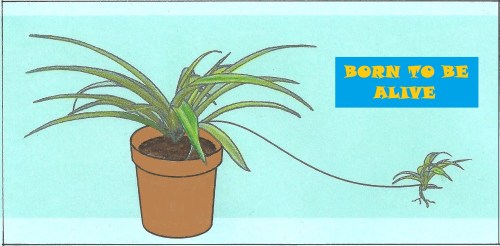
In May 2013 the following drawing has been published, with an explanation about the reproduction of the Chlorophyte,  a plant native from Africa:

e

Chlorophytum comosum

Nobody shows its happiness to be alive better than this plant, the Chlorophyte:

  1. When adult, stretches out a long arm
  2. On its tip, a new plant comes out, smaller however
  3. The new plant grows and, by becoming heavier, touches the ground
  4. The roots that where once hanging on air, now get firmly attached to the earth
  5. The new plant decouples from the old one and the cycle restarts

Celebrate life, take good care of Nature every day !