Our web site aims to find solutions, so that trees living in urban environments do not be cut down unnecessarily. The text presented last December pointed out an idealistic solution to keep fruit-bearing trees in the cities, saying that gathering leaves, branches, seeds and fruits from the ground is a privilege given to good will and conscious people.
Obviously this is just one side of the question. There are other points that we could discuss here, therefore this text is called “2nd vision”. With good reason, a reader made a comment on December’s text, stating that “if fruits are not gathered from the ground, they will become nourishment, especially to rats!”
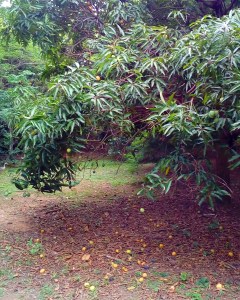
Let us go to the facts: in nature, a fruit-bearing tree let its fruits fall on the soil, and these will serve, among other things, as food for wild animals. Birds, squirrels and other rodents will be benefited from the fruits. The picture below shows a mango tree in the woods. Note how many fruits are splattered over the ground, during the spring and summer seasons.
If we plant a tree of this species (mango tree) in a sidewalk, the fact will repeat itself. In the warm seasons, fruits will fall on the ground in a plentiful manner, if not harvested before. Fruits in sidewalks roll over when they fall, and move rapidly by the action of wind and rain. They may clog drains and prevent rain waters of being collected by the subterranean pipework, and flooding can happen therefore. See below the photo of a drain covered by leaves and fruits.
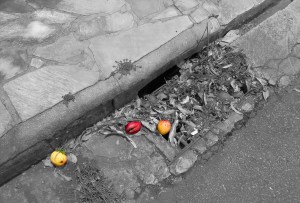
Note that the mangos, enhanced with colors in the photo, are splitting. If nobody takes them from the sidewalk, they might serve as food to rats, which are commonly found in cities and are capable of transmitting diseases to us, human beings. We have raised, therefore, two important urban problems: flooding and rodents proliferation. Now let us analyze suitable solutions.
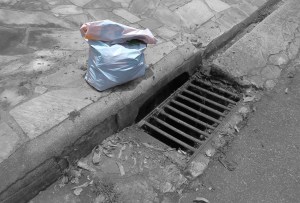
To sweep streets and put leaves and fruits in plastic bags is an immediate solution. See in the picture above how a clean drain looks like. See the bag with all the gathered material that was on and around the drain.
Remembering the reader’s comment that “good sense is necessary when planting a tree”, we can propose two more solutions. First is not to plant fruit-bearing trees in urban sidewalks, but in suitable places (parks or planned gardens).
Another initiative is to choose suitable species for urban environments before planting. For already existing fruit-bearing trees, a constant maintenance is absolutely necessary. It is not fair to plant a tree in an environment created by men, for men’s use (cities) and later hand this tree to the care of “Mother Nature”.
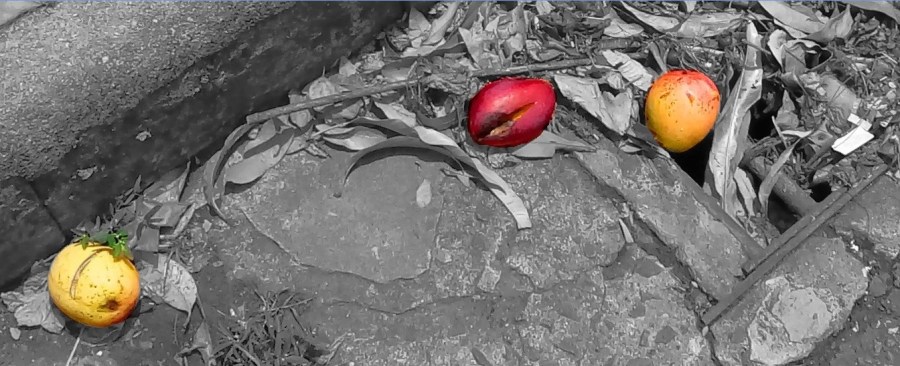
It is a pity to see delicious fruits like these ones in the photo, just thrown on the ground. An urban harvesting program, efficiently handled is another proposal to solve this problem. Volunteer groups or paid businesses could do a systematic harvesting job, to calendar. This would meet the commitment to keep the urban environment clean and at the same time protect trees from being unnecessarily cut down.

 Natura Futura